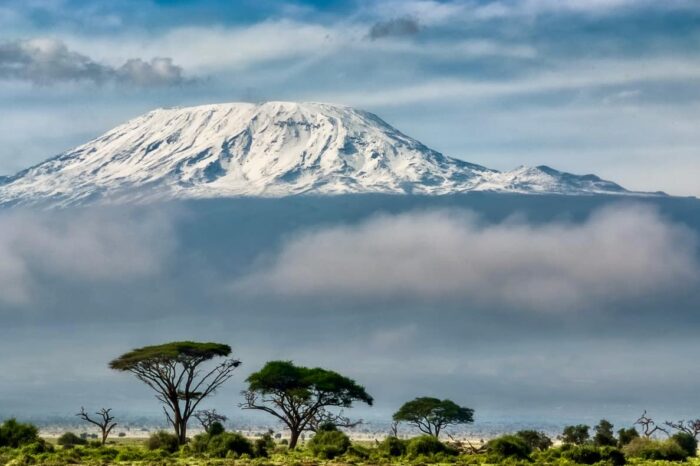
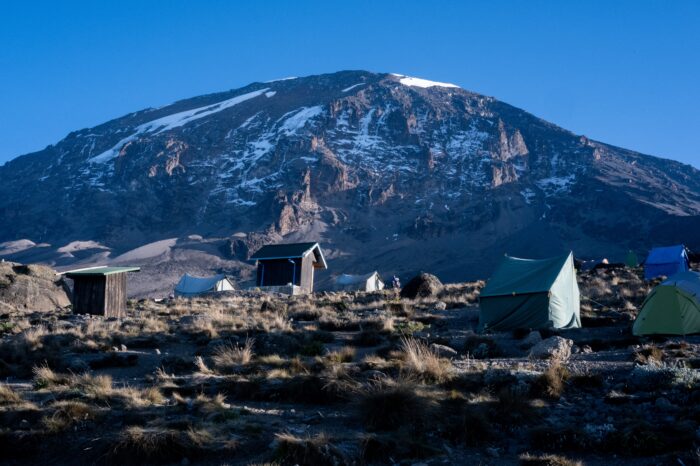
Part of the Eastern Rift Mountains just south of the equator, Kilimanjaro’s snow-capped peaks tower over the surrounding plains. Climbing the 5,895 m (19,341 ft) Mount Kilimanjaro also known as ‘the Roof of Africa’ is both a test of endurance and a celebration of the human spirit.
Mount Kilimanjaro is located in Tanzania, a country in East Africa. The mountain size is 1668 sq km /641 sq miles and its one of the seven summits the highest peaks on each of the seven continents. Mt Kilimanjaro rises 5,895 meters or 19,340 feet above sea level. It is a dormant volcano , Its last eruption was 200 – 300 years ago. Comprised of three cones – Kibo, Mawenzi and Shira. The highest point is on the Kibo cone, and is named Uhuru , which means freedom in Swahili.
Mount Kilimanjaro is a major tourist attraction for experienced and beginning climbers. To get to the mountain, the most convenient way is to fly into Tanzania Kilimanjaro International Airport , and then travel to Arusha or Moshi, Kilimanjaro’s gateway towns, by vehicle. Both cities are approximately 40 minutes away from the airport and taxi services are readily available. Tanzania Expeditions offers expert travel planning and guides for getting here!
Best time to climb
The best times for climbing Kilimanjaro are the driest months of the year, especially Jan, Feb and Aug, Sep. But any time between Jan—mid March and June—October offers reasonable chances of good. The most important issue is safety, being able to enjoy the hike and have a great experience. We don’t recommend trekking when its a rainy season as The effects of rain, mud, snow, ice and cold can be very strenuous on the body. Correspondingly, your chances of a successful summit also increases significantly with nice weather. Of course, the mountain gets more foot traffic during these periods as well.
How many routes
There are six established routes use while climbing Kilimanjaro They vary in length and difficulty. All except one require you to camp. If you climb Kilimanjaro on the Marangu route your accommodation is in huts and camping is not allowed. Five days is the absolute minimum duration for a Kilimanjaro climb, six is better. If climbing using the Machame route six days is the minimum, seven days is recommended.
Taking an extra day for acclimatization will greatly improve your chances to reach the summit. There are longer treks available for those who can afford them.
Altitude Sickness while climbing Kilimanjaro
If you are planning to climb Kilimanjaro we highly recommend reading our altitude Sickness Acute mountain sickness guide to be familiar what it is, its cause and prevention.
Altitude Sickness (Acute mountain sickness)
Is an illness that ranges from a mild headache and weariness to a life-threatening build-up of fluid in the lungs or brain at high altitudes. Acute altitude sickness is the mildest and most common form. Because more people are traveling to areas of high elevation like climbing Kilimanjaro.
High Altitude: 1500 – 3500 m (5000 – 11500 ft)
Very High Altitude: 3500 – 5500 m (11500 – 18000 ft)
Extreme Altitude: above 5500 m (18000 ft)
Acclimatize and prevent altitude sickness while climbing Kilimanjaro
Acclimatization is the process in which an individual organism adjusts to a gradual change in its environment . So while your climbing Kilimanjaro your body undergoes a process of trying to adapt the altitude transformation.
So, physiologically, what happens during acclimatization is, As you ascend higher into the atmosphere, there is less atmospheric pressure pushing all the air molecules together, so oxygen molecules become few and far between. Read more about acclimatization and how to prevent altitude sickness while climbing Kilimanjaro to get your self informed and prepared you for your trek.